Introduction:
Throughout
the history of the world, battles have been fought between civilizations. These
battles are fought and won by the societies fueled for learning new information
through all aspects of culture and all forms of information. An important
pattern in history viewed by many historians is the rise and fall of
civilizations. Some civilizations have conquered and others have failed. Why does
this happen? The answer is learning. All successful civilizations share the
same trend of having high rates of retrieving and producing new ideas. The
effective societies in history learned Bloom’s taxonomy quickly in a figurative
sense. They learned how to grasp information and apply it deeper than just
knowing and understanding the ideas. Civilizations that followed these
characteristics lasted longer than past forgotten civilizations in history.
If we were to create a civilization of our own, what kind
of foundation of learning would it have? What past civilizations could we model
to get the most efficient and successful civilization ever known? The answer to
these questions will begin the development of a society where learning is the
foundation and education is the most important. A civilization needs three
aspects of learning to produce new ideas and stay thriving as a culture. First,
it needs an educational system where knowledge is vibrant and society is
learning as a whole. Second, it requires enlighten thinkers who think outside
of the box and invent new technologies that forces a society to change. Third,
it’s up to the people to make the most out of their civilization. A lazy
population will never achieve anything that amounts to the Romans or the
Greeks. A productive society will result in the creation of a social structure
that will help develop the civilization to learn and grow their culture. In
this paper I will analyze the three aspects of learning and use them to examine
nine artifacts created in past civilizations after the 1500’s. The purpose of
this paper is to develop a civilization using the nine artifacts as my guide to
understand how civilizations learned and the output they created by studying
their artifacts in detail.
Through
the educational system, the definition of learning is the act of obtaining
information and processing it through Bloom’s taxonomy of learning. During this
life, learning can be much more than that. An active learner follows three characteristics
to enhance their view of the world. First they repeat information to enhance
their memory. Second, they effectively learn from experiences, stories and role
models during their life. They do this by using a growth mindset instead of a
fixed mindset. And third, they actively pursue their weaknesses because failure
results in a drive to work harder towards strengthening flaws. Doing these
actions leads to the overall development of intellect and ultimately learning.
Useful Artifacts:
Machiavelli: The Prince

Date:
1532 Nationality:
Florence, Italy
Author:
Niccolo
Machiavelli Medium: Paper and Ink
The
oldest artifact that will be used for my new civilization is The Prince by Machiavelli. This piece of
writing is very important to learning because it describes how leaders should
act in order to maintain control of their people. Machiavelli argues that
monarchy and control of people using fear instead of love is the ultimate way
to control a nation. The writing of this document shows the learning of other
civilizations to follow this same form of control. Under the construction of my
new civilization, this document could be used as an example of control that
should not be used (Later, I will address the “Two treatise of Government” and
explain why this form of government is a much better solution than
Machiavelli’s form of leadership.) This document would follow the first aspect
of learning under educational increase of the society as a whole. An example of
learning from the document would be the political philosophy view of leadership
and how true character must always be present to lead a nation. This artifact
would be a great source of learning for the new civilization because it would
help the formation of leaders and teachers throughout the society.
95 Theses

Date:
1517 Nationality: Germany
Author:
Martin Luther Medium: Paper and Ink
An artifact that changed the course of many civilizations in the 1600’s was the “95 Theses” wrote by Martin Luther. This document by Martin Luther expresses changes of a system. This piece of writing was a moment in history where religion took a different course in the minds of human beings. He made statements that were against the views of the Catholic Church. In this particular case, the “95 Theses” changed the views of many religious people. These words had power and influenced people’s minds. This document proves that people had independent thought to think for themselves. Independent thinking is a product of finding knowledge for the individual not for a leader or community. This thinking follows the second aspect of a successful civilization—enlightened thinkers who think for themselves. Martin Luther’s ideas came from his growth mindset which made him believe that there are better forms of religious truth. The “95 Theses” show many changes of religious and social components of a civilization. For example, Martin Luther talks about indulgences and how they are not required to reach heaven. This example shows a change in religious belief and makes claims to change how society functions with the act of giving money to the church.
An artifact that changed the course of many civilizations in the 1600’s was the “95 Theses” wrote by Martin Luther. This document by Martin Luther expresses changes of a system. This piece of writing was a moment in history where religion took a different course in the minds of human beings. He made statements that were against the views of the Catholic Church. In this particular case, the “95 Theses” changed the views of many religious people. These words had power and influenced people’s minds. This document proves that people had independent thought to think for themselves. Independent thinking is a product of finding knowledge for the individual not for a leader or community. This thinking follows the second aspect of a successful civilization—enlightened thinkers who think for themselves. Martin Luther’s ideas came from his growth mindset which made him believe that there are better forms of religious truth. The “95 Theses” show many changes of religious and social components of a civilization. For example, Martin Luther talks about indulgences and how they are not required to reach heaven. This example shows a change in religious belief and makes claims to change how society functions with the act of giving money to the church.
David
by Michelangelo

Date:
1504 Nationality: Italian
Sculptor:
Michelangelo Medium: Marble
Another
important artifact to include in my new civilization is “The David” by Michelangelo.
This sculpture portrays the Renaissance man and how it delivers the message of
rebirth. My civilization could learn many important aspects of the Renaissance
man and know that education in all areas of life are important. “during the
Renaissance, artist wanted the viewer to see the emotions of the subject…”
(Strong and Davis). “The David” would follow the first aspect of learning for a
civilization under increase of education by seeing the emotion of the sculptor.
This sculpture describes the emotions of David versus Goliath in the Bible. Michelangelo
effectively engages the viewer to analyze the story of David and what he went
through during his battle against Goliath. This studying requires a new
civilization to develop a growth mindset to understand why David would go up
against a big strong person.
Shakespeare:
Hamlet

Date:
Roughly 1600’s Nationality: British
Author:
William Shakespeare Medium: Paper and Ink
The
play, Hamlet by Shakespeare is a
great artifact from the past British civilizations because it shows a
development of writing that was very new to the people at that time. The use of
this artifact for my civilization would be helpful by providing stories shown
through a play with live action and drama. According to this quote by Strong
and Davis, Shakespeare used creativity to make Hamlet remarkable, “Shakespeare took this unremarkable story and
turned it into a psychological master piece is where his creativity is
revealed.” (141). The use of literature provides learning that would enhance
the civilizations’ ability to obtain new knowledge to increase technology and
creativity. An example where Shakespeare’s literature has made an impact on
learning is the creation of many new words in the English language that will
teach the people a deeper understanding of the language. This literary work
would push my society to be productive and find love in literature.
Isaac Newton

Date:
1642- 1727 Nationality:
English
Person:
Isaac Newton Medium: Human Male
Many
new scientific discoveries came about during the time of Isaac Newton. Newton
is important to past civilizations and modern civilizations because he created
the foundation of physics as we know it today. One of the greats in the science
community, Strong and Davis make this point clearly: “His mind was undoubtedly
very sharp, but another trait may have been just as important to his success as
the world’s greatest scientist.” (769). This attribute of being a great thinker
would influence my society in beneficial ways. His new discoveries affect
components of civilizations that help create products we use today. For
example, the landing on the moon required knowledge about gravity and how it
works. Because of Newton’s discoveries, we were able to safely land on the
moon. My civilization would benefit greatly from Isaac Newton’s studies by the
first aspect of learning. The education in physics would help create buildings,
design machinery, and conduct further scientific research throughout my
society.
Two
Treatises of Government
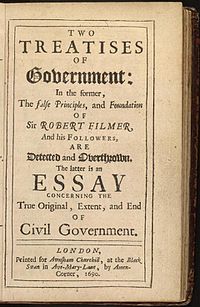
Date:
1689 Nationality: English
Author:
John Locke Medium: Paper and Ink
During
the Enlightenment period, an enlightened figure named John Locke wrote the “Two
Treatises of Government” to address the issues of authority and how the
individual has a divine right to freedom. A few key concepts he states
are: political power is the right to
make laws and regulate property, men are bound to the laws of nature, and
others have a right to punish people who go against God’s will. This document
would be beneficial to my civilization because Locke uses concepts to effectively
teach others to establish a well organized system of society. John Locke
believes that there are natural laws in society that create order which allows
freedom. During this Enlightenment period, many intellectually thinkers thought
of brilliant ideas that challenged reasoning and lead to many discoveries. An
example is Adam Smith. Smith developed an economic system known as capitalism.
Today, we still use this form of economics and it’s still very influential in
our lives. This piece of writing encouraged many Enlightenment thinkers to
change their ideas of how society viewed the individual. Under Bloom’s
taxonomy, this document would give my civilization a standard of learning under
“creating” value because of the magnitude of what John Locke said about
changing rights to the individual. Looking at the big picture, the “Two
Treatise of Government” emerged during a time of great discovery and reason.
This is why Locke’s document would be very influential to my new civilization.
The Origin of Species

Date:
1859 Nationality: British
Author:
Charles Darwin Medium: Paper bound
The writing of Charles Darwin about the means of natural selection came about through his studies on the Galapagos Islands. Darwin was a biologist who loved the study of organisms and how the environment affects the biological creatures within. In the “Origin of Species”, Charles Darwin states new information regarding how biological creatures can change through interactions with their environment. One of Darwin's examples is describing the evolution of finches. For finches to obtain food they must crack shells in order to get the seed. On the island, there were many different types of shells finches had to crack open to receive food. Some finches with smaller beaks could open the smaller shells while finches with bigger beaks could not open smaller shelled seeds. This discovery led to the small beak finch population to survive and reproduce while the big beak population died off. Charles Darwin used this and many more examples of studies he found on the island to convey the message of natural selection. Darwin used analyzing and evaluating to create the idea that organisms actually evolve from how the environment interacts with the organisms instead of organisms spontaneously changing over time. This idea from Charles would arouse thought into my new civilization about science by introducing a new idea through first hand research and evidence. Overall, “The Origin of Species” would be helpful to the civilization by manifesting learning through the creating level of Bloom's taxonomy. Also, Charles Darwin’s ideas regarding evolution and natural selection would show my civilization that science could answer many of life’s important questions.
U.S
Constitution
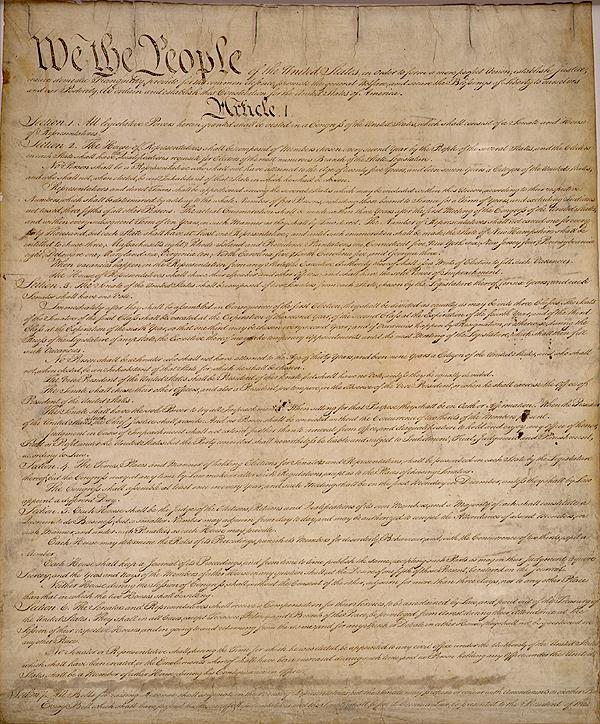
Date:
1789 Nationality: American
Author:
James Madison Medium: Parchment and Ink
An
important document to include in the new civilization is the U.S Constitution.
This artifact would be more desirable than other government structured
documents because it includes the complied ideas of the Founding Fathers into
an agreed structure. The Founding Fathers wrote the Constitution using
knowledge they gained from past civilizations that succeeded for a long period
and from civilizations that failed. Ultimately, the ideas within the U.S.
Constitution are proven to be successful from the practice of past civilizations.
This document would be especially important to my civilization to be able to
structure an effective functioning government. An example why the Constitution
would be useful for a government start-up is the idea of checks and balances.
This idea establishes a fair use of government power without one division of
government overrunning the other. In order for my civilization to grow and
expand quickly, it must implement the ideas of the U.S. Constitution. Also
under the learning aspects for a civilization, the U.S. Constitution provides
education about how government should be structured and how it should function.
It also pushes individuals to work because of the way the government is
structured. Overall, this artifact would be beneficial the civilization to give
order and structure.
Florence Dome

Date:
1436 Nationality: Italian
Architect:
Filippo Brunelleschi Medium: Wood and Bricks
The
architecture of the Florence Dome by Brunelleschi is another great work of art
done through creativity and strong willed determination. Figuratively, this structure
stands tall above all other architecture achievements in history because of the
story behind Filippo Brunelleschi by using creativity and determination. This
is described in Strong and Davis, “[Brunelleschi] revealed his tremendous preparation
for this project and the creative methods he would use rather than the
traditional construction methods which he asserted would not work in the
Florence cathedral.” (16). Filippo
Brunelleschi’s creativity of his structure teaches us how hard work can pay off
even if the task at hand is almost impossible. The component of learning here
is developing creativity and working hard to achieve something great. The
Florence Dome would be a great artifact to include into my civilization because
of the learning aspect of how the dome was built through creative processes. A
civilization needs creative minds to advance in technology; therefore, the
Florence Dome will be included in my new civilization.
During this semester, I have realized that there is much more to learning then just remembering and understanding. I've learned that taking the subject material a step further too really analyze the information helped me create a new thought or idea from it. An example in my life where I have used Bloom’s taxonomy to create value is when I designed and implemented my own business. I wrote the business plan and took all necessary action to make a profit and exceed in the world of business. The best situations I learn are with my role models. Every day I spend time with them and I learn a new way to perform a task or complete an assignment. In these situations, I learn best by applying myself and actually doing the task. For example, when my dad was teaching me how to shoot a basketball, not only did I listen but I also took action to what he told me by doing exactly what he said. This allowed me to perform the task of shooting a basketball well and made it stick in my head so I can later perform the same task in the future. The best way I can apply this concept to school work is by doing “hands-on” studying for the class material. I think by analyzing and interpreting ideas from class, I can better understand it and be able to remember it better just like I do with hands-on tasks with my role models. I feel there is always a better way to learn different things and I will continue to learn how to find the most efficient ways to learn at BYU. As I develop this way of learning, how would it impact modern day civilizations? The civilizations in this new technology era are much more advanced then civilizations of old. My definition of learning can still apply now because deep learning requires a growth mindset. As individuals and communities continue to search deep for knowledge and look past the understanding of the product by finding ways to create the element. If we as a human society continue to pursue these actions of growth mindset then we will continue to grow as a whole.

No comments:
Post a Comment